AI voice phishing turned the IT help desk into a primary breach entry point. Attackers impersonate employees on the phone and pressure agents into resetting credentials or MFA, then log in with valid access. The five directives that stop it: out-of-band identity verification, FIDO2 MFA, manager approval on high-risk changes, monitoring for the reset pattern, and recurring vishing simulations. For a cybersecurity owner (CISOs, GRC managers) , the takeaway is short: your help desk password-reset workflow is now a control gap, and most awareness programs never test it. The rest of this article explains why, with current data, and gives you a prioritized directive table to act on.
Key takeaways
- Vishing is the #2 initial breach vector, and the IT help desk is the most common landing point.
- AI voice cloning makes targeted impersonation cheap, fast, and convincing.
- Help-desk attacks produce valid logins, so EDR and email gateways never see them.
- Five directives stop it: out-of-band verification, FIDO2 MFA, manager approval, monitoring, and recurring simulations.
- Some threat actors reached exfiltration in four minutes, so prevention beats detection.
What is AI-assisted vishing?
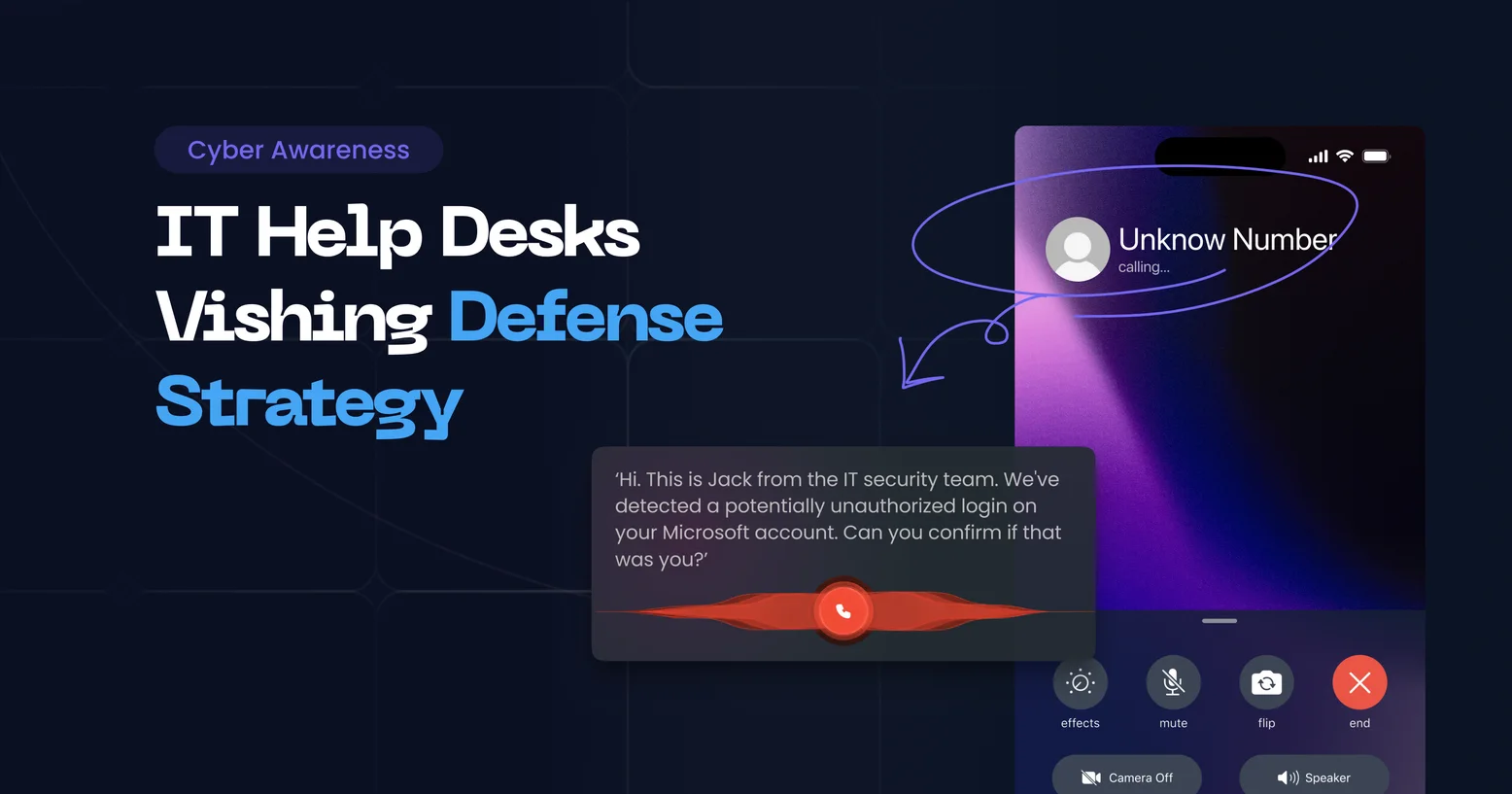
AI-assisted vishing is voice phishing supercharged with generative AI and voice cloning. Attackers can build credible synthetic voices and even clone a voice from seconds of public audio and run real-time, adaptive calls that impersonate employees or IT staff. The goal is to manipulate a help desk agent or end user into resetting credentials, approving an MFA prompt, or installing remote-access software. No malware required. AI removed the two limits on voice fraud: the attacker's time and skill. Voice bots now pre-screen victims at scale, and cloned voices pass human judgment. The result is a call that sounds like a stressed colleague who knows your internal jargon. See why vishing became the #2 threat vector in 2026 for the full shift.
Why do attackers target IT help desks?
IT help desks hold the keys to identity. Agents can reset passwords, register MFA devices, and unlock privileged accounts, often under time pressure and with weak caller verification. One convincing call produces valid logins, so there is no malware, no phishing page, and nothing for EDR or email gateways to detect.
Per Mandiant's technical analysis of vishing threats, two playbooks define the risk:
- UNC3944 (Scattered Spider): calls the service desk impersonating employees to reset passwords and MFA, then pivots to SIM swapping, ransomware, and extortion.
- UNC6040: impersonates IT support to trick employees into authorizing a malicious Salesforce app, enabling mass CRM theft and data extortion.
Publicly reported help-desk victims include M&S, Co-op, Harrods, Chanel, Pandora, Adidas, and Qantas (Infosecurity Europe, 2025). The typical pretext: a "forgotten password" from someone whose phone is lost or who is flagged on PTO via an out-of-office reply. A common escalation reset MFA with one agent, then call back to a second agent for the password, often blending into callback vishing.
Vishing statistics your should know about
| Figure | What it means |
|---|---|
| #2 (11%) | Vishing is now the second most common initial infection vector overall. (M-Trends 2026 Mandiant / Google) |
| 23% | Voice phishing was the top initial vector for cloud-related compromises. (M-Trends 2026 Mandiant / Google) |
| +40% | Users fall for mobile vectors (voice, SMS) 40% more than email phishing. (Verizon 2026 DBIR) |
| $30M+ | AI-enabled BEC losses from voice-cloned wire-transfer fraud in 2025. (FBI IC3 2025 Internet Crime Report) |
| 4 minutes | Chatty Spider went from answered call to attempted exfiltration in four minutes. (CrowdStrike 2026 Global Threat Report) |
The four-minute figure is the one for your board: detection timelines measured in hours do not help when exfiltration starts minutes after a single call.
How do you defend against AI help desk vishing?
Defense is layered, not a single fix. The directive table below is the at-a-glance version; the controls that follow add the detail. Priorities are flagged for a cybersecurity owner deciding sequence.
| Priority | Directive | Control |
|---|---|---|
| Critical | Verify identity out-of-band before any reset | On-camera ID check against an internal photo database, or callback to a registered number. Disable self-service resets for privileged accounts. |
| Critical | Make MFA phishing-resistant | FIDO2 hardware keys for admins; remove SMS, voice, and email-link factors. |
| High | Put a second human on high-risk changes | Manager approval via a verified channel; alert on sequential MFA + password resets. |
| High | Segregate and monitor | Split customer vs internal help-desk permissions; feed sign-ins to SIEM/SOAR; flag risky Entra logins and residential-VPN access. |
| Recurring | Train the reflex with live AI calls | Recurring multi-channel vishing simulations across the whole workforce, not just VIPs. |
Verify identity out-of-band, every time
Train agents to confirm identity before changing any account. Mandiant recommends on-camera verification with a corporate ID, challenge questions not discoverable online, and out-of-band callbacks for high-risk resets. During heightened threat, route all resets through a manual workflow with enhanced scrutiny.
Enforce phishing-resistant MFA
Standardize FIDO2 keys for privileged users and strip out SMS, voice, and email-link factors, which are exactly what vishing and SIM swapping exploit. Restrict MFA registration to trusted IPs and compliant devices, and alert when one phone number is registered across multiple accounts.
Train against real AI calls, not slideshows
Technical controls fail the moment an agent decides to be helpful. You can't slide-deck your way through a live intrusion phone call. Resistance is a trained reflex, built through live, repeated practice, and most programs test email phishing only, leaving the fastest-growing vector untested.
Where Arsen fits the defense stack
Arsen's vishing simulation runs realistic, AI-driven calls across your entire workforce, so people feel the attack safely before it's real. Unlike decision-tree tools, it holds an adaptive, unscripted conversation that handles objections in real time.
It tests the full attack as a coordinated, multi-vector kill chain:
- Voice call: human-like AI caller that adapts to the target.
- Spear-phishing email or SMS: triggered by the call, matched to its pretext.
- Landing page: credential-capture or malware-download simulation.
- Training page: just-in-time micro-learning while the moment is fresh.
The outcomes a cybersecurity owner can report on: coverage of every exposed employee (not just the C-suite), the actual channels attackers use (voice + SMS + email in one chain), progressive sequences that build reflexes under pressure, and measured resilience over time via real-time reporting.
How to Bypass MFA Using a Callbot
Discover our video to show how a callbot can be used to bypass MFA, generally following a credential leak or credential harvesting phishing.
Watch our video
Frequently Asked Questions
-
Voice phishing that uses generative AI and voice cloning to impersonate a specific person in real time. Attackers clone a voice from short audio samples and run adaptive calls to manipulate help desks or employees into resetting credentials or approving MFA.
-
Help desk agents can reset passwords and MFA for privileged accounts, often under pressure and without strong verification. A successful call yields valid credentials, so no malware exists for endpoint security to catch.
-
No. Attackers target the reset process itself. You need phishing-resistant MFA (FIDO2) plus out-of-band identity verification and manager approval for resets, working together.
-
They turn untested awareness into measured resilience. Realistic AI calls expose which agents and users comply, give you reportable metrics over time, and harden the help-desk workflow that audits and frameworks increasingly expect you to control.
Test your help desk before an attacker does
Your controls are only as strong as the agent who decides whether to trust a voice. See how your service desk and privileged users respond to a realistic AI vishing call, then close the gaps.
Download our vishing solution brief →