Regulation rarely moves as fast as the threats it is designed to address. But in 2026, catch up may happen. Frameworks like the EU AI Act, NIST AI RMF, and DORA are being actively reshaped to account for autonomous AI threats, and enforcement is no longer on the horizon. It is already here.
For CISOs at banks, insurers, and fintechs, this shift carries real operational weight. The FTC has begun enforcing rules against deceptive AI-driven practices, DORA's implementation phases are actively running, and regulators across jurisdictions are signaling that scrutiny will only intensify through 2026 and beyond. Firms that treat compliance as a checkbox exercise are running out of time.
The pressure points are clear: tighter AI governance requirements, more rigorous third-party vendor auditing, and higher expectations around incident response. The organizations best positioned to navigate this landscape are those that understand what is coming, and start building toward it now.
Key Takeways
- Adaptation: Regulators are shifting from passive guidelines to active, risk-based frameworks like the EU AI Act to address autonomous threats.
- Accountability: Enforcement has moved to the forefront, with agencies actively penalizing deceptive practices and requiring transparency in high-stakes sectors.
- Integration: Compliance is no longer a silo; firms must embed AI-specific protocols into general governance, vendor management, and incident response.
Potential & Known Regulatory Evolutions to Anticipate in 2026
Regulatory Frameworks & Standards
Operational Resilience & AI Governance: DORA mandates resilience against all ICT disruptions, requiring firms to withstand attacks regardless of sophistication (including offensive AI). Conversely, the EU AI Act governs internal AI adoption, ensuring systems are safe and compliant rather than focusing on external defense.
Adaptive Oversight: While DORA is technology-neutral, testing frameworks like TIBER-EU are updating scenarios to include AI-amplified threats. Oversight now prioritizes harmonizing DORA and GDPR to ensure supply chain security and rapid reporting against these faster, automated attacks.
Enforcement Actions
Deceptive Practice Crackdowns: Launch of initiatives like the FTC's "Operation AI Comply" (Sept 2024) to penalize deceptive AI usage.
Financial Services Regulation: Proposed rules by the U.S. Consumer Financial Protection Bureau to mitigate bias and fraud in financial AI applications.
Corporate Governance & Operations
Integrated Compliance: Requirement for firms to embed AI risk assessments directly into existing compliance programs.
Vendor & Incident Management: Mandates for ensuring third-party AI vendors meet strict security standards and updating incident response plans specifically for AI-driven attacks.
Strategic Collaboration
Intelligence Sharing: Establishment of public-private initiatives to share threat intelligence regarding AI-specific cyber risks.
Regulatory preparedness and threat resilience are two sides of the same coin.
Understanding what regulators expect is essential, but so is understanding the threat landscape your teams are up against every day. Arsen's 2026 Social Engineering Risk Report for Financial Services gives you the full picture, from why social engineering remains the top threat vector in financial services, to how AI is reshaping phishing and impersonation attacks at scale, to what your defenses need to look like going forward. 45% of financial services firms faced AI-powered attacks last year. The most resilient organizations are not waiting for the next regulatory update to act.
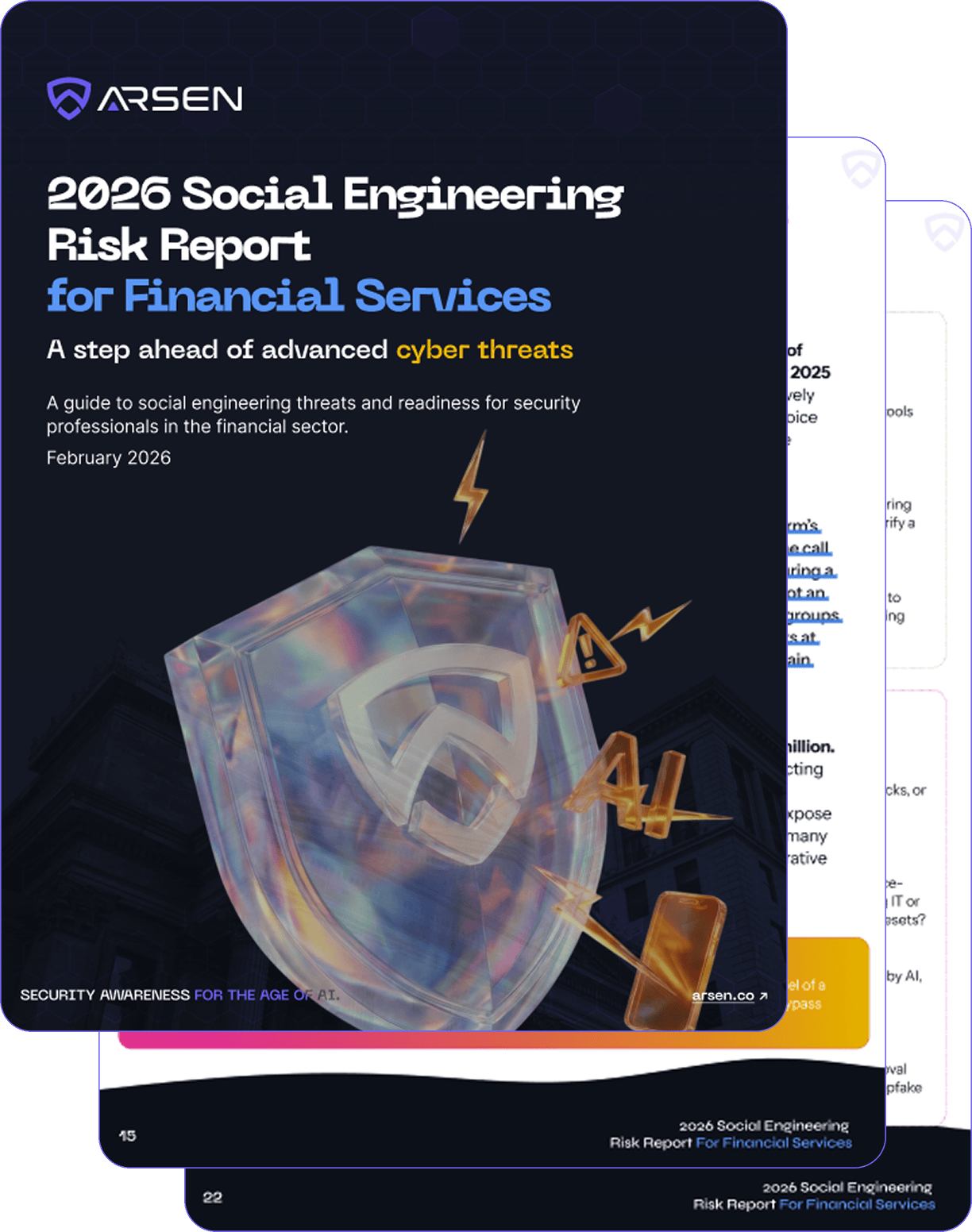
Stay ahead of advanced cyber threats. Discover key social engineering risks and readiness insights for financial security leaders.