
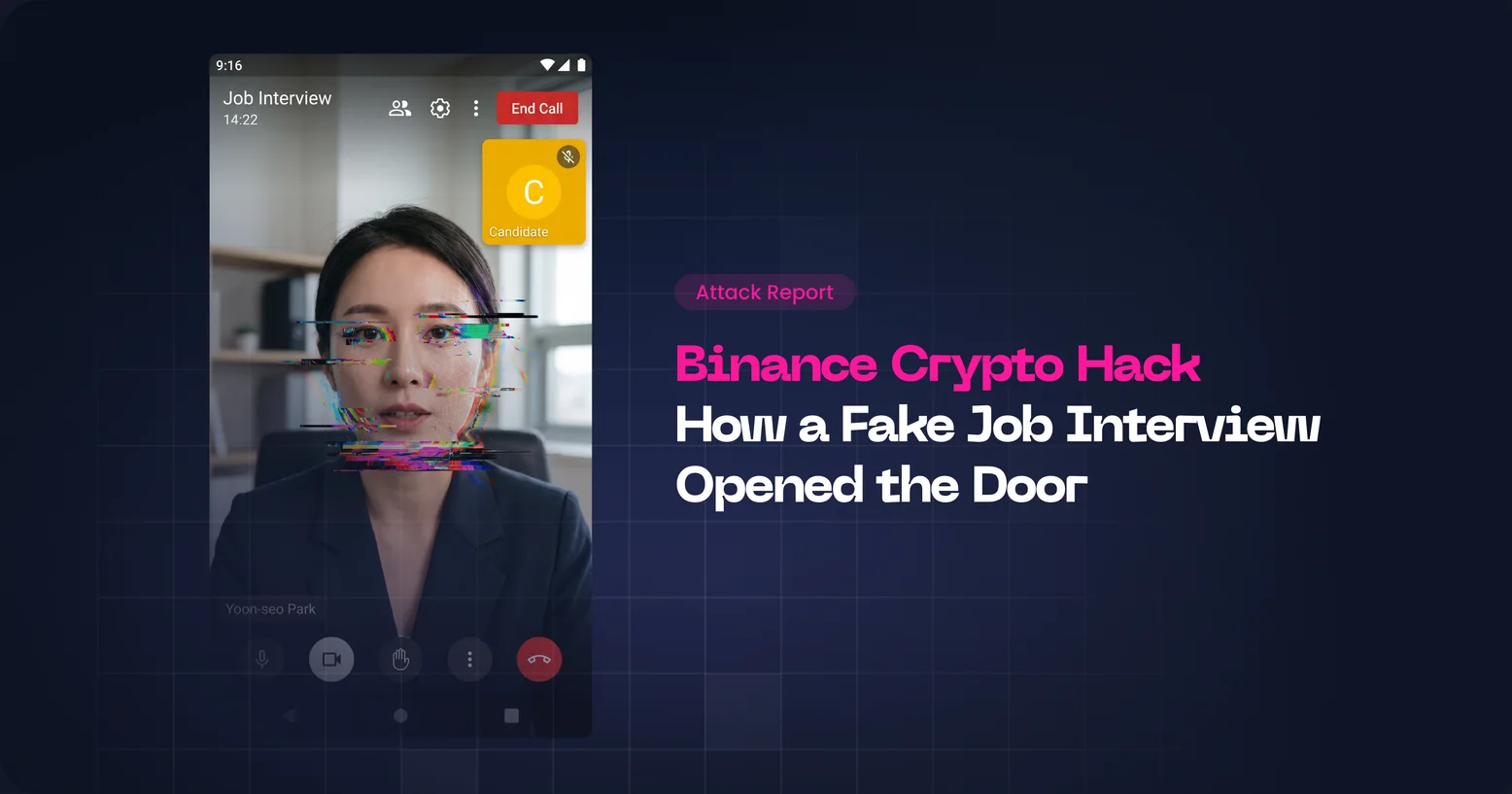
The Binance hack started with a fake job interview: a software engineer ran a take-home coding assignment on a work laptop. Weeks later, attackers used a stolen deployment token to drain $6.34 billion from Binance hot wallets.
Key takeaways
- The initial access was social engineering, not a technical exploit: a fake recruiter, two interview rounds and a coding assignment run on a work computer.
- A June supply chain infection had already exposed who managed Binance's wallet infrastructure, so the September approach was targeted.
- The attackers moved from one laptop to wallet engineers through an internal AI tool, then used a deployment token stored on a laptop.
- Deepfakes were not needed. A believable hiring process and a routine take-home test were enough.
- The controls that would have broken the chain sit in HR policy, endpoint rules and access design as much as in awareness training.
What happened in the Binance hack?
On 29 October 2026, attackers used Binance's internal wallet signing service to send about $6.34 billion in digital assets from its hot wallets to addresses they controlled. Binance published its initial findings on 3 November, and the FBI attributed the theft to North Korea's TraderTraitor group.
In its initial findings report, Binance says the incident "should not have happened" and that it will cover the losses, with more than 100% of the needed funds set aside. The FBI, the Secret Service and the IRS asked exchanges to block transactions linked to TraderTraitor addresses, as The Record reported.
| Item | What Binance reports |
|---|---|
| Date of the theft | 29 October 2026 (UTC) |
| Assets impacted | About $6.34 billion |
| Assets moved | 233.46 million XRP, about 970,500 SOL, 44.2 million OP, 18,270 BTC and 2,961.9 ETH |
| Frozen or intercepted | About $2.85 billion, subject to reconciliation |
| Customer impact | 98% of impacted tokens replenished by 31 October, losses covered by Binance |
| Attribution | North Korea, per an FBI alert (TraderTraitor) |
How did the attackers get into Binance?
The attackers spent about five months preparing. A tampered developer tool exposed the wallet team in June, a fake job interview compromised a software engineer in September, and an internal AI tool carried the attackers to the wallet engineers in October.
How did the fake job interview work?
The fake interview copied a normal hiring process. Binance describes three steps, each designed to build trust before the one request that mattered: running the attacker's code on a work computer.
- First round, video interview with "HR". The interviewer built rapport by sharing personal social media content.
- Second round, chat interview with a "CEO". A person claiming to be the CEO of the hiring company continued the process in a chat app.
- The assignment. The engineer was asked to download a code repository onto a work computer. Its setup script swapped pyenv for a malicious version, removed the original, created a new symlink and launched a shell, with obfuscation to avoid detection.
Reuters reported Binance's account that hackers used a fake job interview to compromise a computer, and Bloomberg described the same fake job interviews behind the record heist. The target was a current employee looking at an outside offer, not a candidate applying to Binance.
Why did the June infection matter?
The June incident was contained, but it was not over. Binance replaced the device and rotated credentials, yet the attackers kept what they had learned about the wallet team: who held which role and who to approach next.
That reconnaissance is what made the September approach targeted. Fortune reported that the attackers learned details about the engineer's role and about others who managed company wallets before the interview started. An incident review that closes on "device replaced" misses the information the attacker walks away with.
What role did AI play?
AI was not the way in. Binance told Fortune that initial access relied mainly on conventional phishing, and that AI played a role only later, when the attackers used an internal AI tool on the compromised laptop to take control of other engineers' accounts.
That makes internal AI assistants an access path in their own right. A tool that can act across colleagues' systems carries the reach of every permission it holds, and Binance has since rebuilt it with new access controls.
What is the fake job interview attack?
The fake job interview attack is a social engineering technique in which attackers pose as recruiters, run a credible hiring process and ask the target to complete a coding test or download a file that installs malware. It targets developers and engineers, whose laptops often hold access to source code, cloud consoles and production systems.
North Korean groups have run this playbook at scale. A joint advisory from agencies in Japan, the US, Australia and Germany states that the "Contagious Interview" campaign has compromised at least 30,000 devices in more than 100 countries and drained funds or credentials from over 7,000 cryptocurrency wallets, as The Hacker News reported in September 2026. Operators contact developers on social media, especially LinkedIn, build rapport, then send the coding test that starts the infection.
Does the attack need a deepfake?
No. Binance's report mentions a video interview but does not say the interviewer was synthetic, and the attack works with a real person on camera. A deepfake face or a cloned voice can make a fake recruiter more convincing, but the decisive step is the same either way: the target runs the attacker's code on a machine with access to company systems.
The same pattern appears in other social engineering tactics targeting crypto teams, where the pretext changes but the request stays the same: install, sign or share.
Read Binance's post on the incident on X →
Why are crypto firms such frequent targets?
Crypto firms hold liquid assets that move in minutes and settle irreversibly, so one compromised engineer can be worth billions. Binance says it detected and blocked 57 suspected North Korea-linked threat cases in 2026 before this one succeeded.
Engineers at exchanges are also easy to find. A Binance spokesperson told Fortune that employees who are not public-facing may not keep LinkedIn profiles, a policy aimed at exactly this kind of approach. The broader reasons crypto firms draw more phishing than other sectors apply here, and the pattern matches earlier cases where people were the entry point of a crypto token compromise.
What should security teams learn from the Binance hack?
The Binance hack shows that one social engineering success becomes a catastrophic loss only when access design lets it. Each stage of the chain offered a point where a policy, a technical control or a trained reflex could have stopped it.
| Attack stage | What happened | Control that breaks it |
|---|---|---|
| Reconnaissance | June infection exposed the wallet team | Treat exposed org data as part of the incident |
| Approach | Fake recruiter on a job platform | Limit public profiles for sensitive roles |
| Execution | Coding assignment run on a work laptop | Never run external code on work devices |
| Lateral movement | Internal AI tool reached other engineers | Treat AI tools as privileged access |
| Theft | Deployment token stored on a laptop | Short-lived tokens and a second approver |
The human controls are the cheapest to deploy and the first ones the attackers met:
- Tell employees that outside interviews, take-home tests and "quick assignments" never run on company devices.
- Give engineers a simple way to report recruiter approaches, without judging why they were job hunting.
- Train developers on fake recruiter and coding test lures, not only on email phishing.
- Restrict which tools can be installed, and point engineers to approved sources for package managers and AI coding tools.
- After any endpoint incident, list what the attacker could have learned about people and roles, and warn those people.
- Review which roles appear on public profiles and job platforms, starting with wallet, signing and infrastructure teams.
Our crypto CISO checklist against social engineering covers the wider program.
How can crypto teams prepare employees for these attacks?
Crypto teams prepare employees by putting them through realistic, multi-step social engineering scenarios built on their own workflows, then training them right after a miss. Knowing that fake recruiters exist rarely helps in the moment; practicing the refusal does.
Arsen's human risk management for crypto teams runs multi-step conversational attack scenarios based on internal workflows and approval chains, AI vishing calls, deepfake executive impersonation, and simulations of wallet-signing abuse and account takeover. Employees who fail a simulation receive just-in-time training, and results are reported by entity, region and team.
Frequently asked questions about the Binance hack
-
Attackers compromised a Binance software engineer through a fake job interview whose coding assignment installed malware on a work computer. From there, they used an internal AI tool to reach wallet engineers, stole a container deployment token and used it to drain hot wallets through the wallet signing service on 29 October 2026.
-
The FBI attributed the theft to TraderTraitor, a North Korean hacking group. Binance cites the FBI alert in its initial findings and says it had blocked 57 suspected North Korea-linked threat cases earlier in 2026.
-
Binance reports about $6.34 billion in impacted digital assets, of which about $2.85 billion was frozen or intercepted. It says it covers the losses and had replenished 98% of impacted tokens by 31 October 2026.
-
It is a social engineering attack in which a fake recruiter runs a credible hiring process, then asks the target to complete a coding test or download a file that installs malware. It mainly targets developers, whose work devices often hold access to code and production systems.
-
Forbid running external code or interview assignments on work devices, limit public profiles for sensitive roles, and train engineers to recognize and report recruiter lures. Pair that with access design that keeps standing tokens off laptops, so one compromised device cannot reach critical systems.