Deepfake awareness training prepares employees to verify a request before acting on it, even when the voice or face on the call belongs to a leader they know. It combines learning about deepfakes with practice against realistic cloned-voice calls and video meetings, so that verifying becomes a reflex rather than a rule people remember.
Key takeaways
- The control that stops deepfake fraud today is a verification habit, not the ability to spot a fake.
- In a 2025 Gartner survey, 62% of organizations reported at least one deepfake attack in the previous 12 months.
- Train finance, HR and payroll, executive assistants and the IT helpdesk first: they hold the actions attackers want.
- Short content monthly and live simulations at least quarterly for high-risk roles keep the habit alive.
What is deepfake awareness training?
Deepfake awareness training teaches employees how AI-generated voices and videos are used to impersonate trusted people, and how to respond when a request arrives through one. Its goal is behavior: pausing, verifying through a separate channel and escalating, whatever the caller looks or sounds like.
Two activities sit under the same name. Learning about deepfakes covers videos, e-learning modules and examples that explain the threat. Practicing against them means receiving a simulated cloned-voice call or joining a simulated video meeting, then getting feedback on what you did. The first builds knowledge. The second builds the reflex that knowledge alone rarely produces under pressure.
Why do organizations need deepfake training now?
Deepfake attacks are no longer rare events reserved for large enterprises. In a September 2025 survey of 302 cybersecurity leaders, Gartner found that 62% of organizations had faced at least one deepfake attack in the previous 12 months, involving social engineering or the abuse of automated processes.
Deepfake incidents reported by organizations (Gartner, 2025)
Share of organizations surveyed
The losses are material. Pindrop's 2026 Deepfake Readiness Index, based on more than 250 US security leaders, found that 74% suspected a deepfake attack in the last 12 months and that one in four of those reported losses above $1 million from a single incident, as Infosecurity Magazine reported. The best-known case remains Arup, where an employee in Hong Kong transferred HK$200 million (about US$25.6 million) in 15 transactions after a video call with deepfakes of the company's CFO and colleagues, as Fortune reported.
How do deepfake attacks on companies work?
Most deepfake attacks on companies follow three patterns: a phone call in a cloned voice, a video meeting with a synthetic participant, or a chain that combines several channels so each step makes the next one more credible. All three aim at an action, such as a payment, a password reset or a file transfer.
Cloned-voice call
An attacker clones a leader's voice from a few seconds of public audio, such as a conference talk or a podcast, and calls an employee. The voice asks for something urgent and confidential: a supplier payment, a change of bank details, an exception to a process. The short duration of a call leaves little time to doubt.
Deepfake video meeting
The employee receives a meeting invite from what looks like an executive's account. On the call, one or several participants are AI-generated likenesses of real colleagues. Seeing familiar faces is exactly what makes the request feel verified, which is how the Arup transfers happened.
Multi-channel chains
The most convincing attacks use one channel to prepare the next.
Our comparison of deepfake, vishing and phishing attacks explains where each technique fits.
What do real deepfake cases teach?
Publicly reported cases show a consistent pattern: losses happen when the target treats a familiar voice or face as proof of identity, and attempts fail when someone asks a question only the real person could answer or checks through another channel.
| Case | Channel | Outcome | What decided it |
|---|---|---|---|
| UK energy firm, 2019 | Cloned-voice phone call | €220,000 lost | The CEO recognized his boss's voice and paid within the hour |
| Arup, 2024 | Deepfake video call | HK$200 million lost | Familiar faces on camera overcame initial doubt |
| WPP, 2024 | Teams meeting with a voice clone | Stopped | The executive targeted stayed vigilant |
| Ferrari, 2024 | WhatsApp messages, then a cloned-voice call | Stopped | A question only the real CEO could answer |
In the 2019 case, the chief executive of a UK energy company transferred €220,000 (about US$243,000) to a supposed Hungarian supplier after a call in which he believed he was speaking to the head of the German parent company, as Bitdefender summarized from The Wall Street Journal's reporting. The fraud surfaced only when the attackers called again for a second payment.
The two stopped attempts show what works. At WPP, attackers used a fake WhatsApp account, a Teams meeting, a voice clone of CEO Mark Read and YouTube footage of him to ask a senior executive to set up a new business, and the company credited "the vigilance of our people", as TechInformed reported. At Ferrari, an executive who received a call in the cloned voice of CEO Benedetto Vigna asked the caller to name a book Vigna had recommended days earlier, and the call ended abruptly, as Bloomberg reported via Fortune.
What verification protocol stops deepfake fraud?
A verification protocol is a short set of rules employees apply whenever a request is urgent, secret or unusual, regardless of who appears to be asking. Five rules cover most attacks, and they work because none of them depends on spotting a fake.
Which roles need deepfake training first?
Start with the people whose actions attackers want: those who move money, change payroll data, act on behalf of executives or reset access. Each role faces a recognizable request, and each has a specific check that stops it.
| Role | What attackers ask for | The check that stops it |
|---|---|---|
| Finance and accounts payable | An urgent transfer or new supplier bank details | Callback on a known number and dual approval |
| HR and payroll | A salary account change or employee records | Confirmation through the HR system, never by call alone |
| Executives and their assistants | A confidential deal, a signature or a gift card purchase | Code word and a check with the executive's office |
| IT helpdesk | A password or MFA reset for a "traveling" leader | Identity verification through a second channel before any reset |
What does effective deepfake awareness training include?
Effective programs put people in realistic situations, give feedback at the moment it matters and measure behavior over time. Four elements make the difference between a module employees complete and a habit they keep.
- Realistic scenarios built on your own leaders. A simulated call from the CFO employees actually work with tests the real risk. A generic voice tests very little.
- Coaching at the moment of failure. A short lesson right after a missed verification is remembered far better than a reminder weeks later.
- A regular cadence. One session a year does not survive the next urgent request. Repetition is what turns the protocol into a reflex.
- Behavior metrics. Track who verified, who complied and who reported, by department and over time, so you can direct effort where it is needed.
How do the main approaches to deepfake training compare?
Awareness videos, personalized deepfake videos and live simulations answer different needs, and most mature programs combine them. The choice depends on whether you want people to know about deepfakes or to act correctly when one reaches them.
| Approach | What it builds | Strength | Best used for |
|---|---|---|---|
| Awareness videos and e-learning | Knowledge of the threat | Reaches everyone quickly | Baseline for all employees |
| Personalized deepfake videos in training | Recognition of a familiar leader faked | Makes the risk concrete | Launching or refreshing the program |
| Live simulations by phone and video call | The verification reflex under pressure | Measures real behavior | High-risk roles, at regular intervals |
Deepfake detection tools belong to a different layer. They flag synthetic media in some channels, but they cannot decide whether an employee pauses and calls back. Our guide to what deepfake detection tools catch and what they miss covers that boundary.
How often should employees be trained on deepfakes?
Run short awareness content monthly for all employees and live simulations at least quarterly for high-risk roles such as finance, HR, executive assistants and the IT helpdesk. Add a session when a new executive joins, after a reported attempt, or when a process involving payments or access changes.
The monthly content keeps the protocol visible. The quarterly simulations check whether people apply it when a familiar voice or face asks for something urgent.
How can you practice against realistic deepfakes with Arsen?
Arsen runs two deepfake simulations, a cloned-voice call and a deepfake video call, inside one social engineering training suite. They use the same engine, dashboard and reports as Arsen's phishing and vishing simulations, so deepfake results sit alongside the rest of your human risk data.
- Custom scenarios for your organization. Arsen builds scenarios and environments for each company, department or internal profile: precise, workflow-specific scenarios for finance teams who approve payments, or broader ones that measure risk at scale across larger teams.
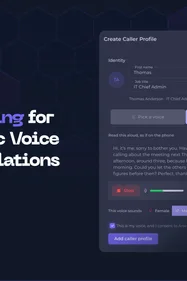
- Voice cloning vishing. An executive or manager records 10 to 60 seconds of their voice in Arsen, and the clone is ready within seconds. It powers an AI caller that adapts in real time, with scripts in English, French, German, Spanish, Italian, Dutch and Portuguese. Calls can be goal-driven elicitation calls or phone-to-phish scenarios with a follow-up email and landing page, as the voice cloning release note details.
- Consent built in. The speaker records live and ticks a consent statement. There is no audio upload, the raw recording is deleted once the voice is cloned, and an audit record is kept.
- Deepfake video calls. Employees receive a meeting invite from one of your executives, then join a pixel-accurate video call interface with an AI-generated likeness of that leader. The staged scenario leads to a simulated malware delivery or account compromise. Arsen builds the persona, scenario, follow-up assets and send calendar for you, as described in our article on deepfake executive fraud simulation.
- Training after every miss. A micro-learning follows every failed simulation, and results point to adaptive, interactive awareness lessons that train employees on the situation they missed.
- Audit-ready results. Each call gets a graded outcome (compromised, resisted or no result). Video campaigns show a funnel from invites sent to invites opened, calls joined and employees compromised, by department and by employee.
Available platforms for deepfake video call simulations:
 Microsoft Teams
 Google Meet
 Zoom
See how Arsen deepfake simulations work →
For voice-only programs, Arsen vishing simulation runs the same AI caller without the video layer. Before using a cloned executive voice, review the legal considerations of AI voice phishing simulations with your legal team.
Deepfake awareness training checklist
- Write the five-rule verification protocol and publish it to all employees.
- Agree on code words or verification questions for payments and access changes.
- Ask executives to state publicly that they expect to be called back.
- List the roles that can move money, change payroll data or reset access.
- Brief finance, HR, executive assistants and the IT helpdesk on the requests they are likely to receive.
- Run monthly awareness content for all employees.
- Schedule cloned-voice and video call simulations at least quarterly for high-risk roles.
- Pair every failed simulation with immediate coaching.
- Track who verified, who complied and who reported, by department.
- Review the protocol after every real or simulated incident.
Frequently asked questions about deepfake awareness training
-
Deepfake awareness training teaches employees how AI-generated voices and videos are used to impersonate trusted people, and how to verify a request before acting on it. It combines learning content about the threat with practice against realistic simulated calls and video meetings.
-
Yes. Many security awareness programs include deepfake modules, usually short videos or e-learning lessons. A course builds knowledge of the threat, but employees also need practice through simulated calls or video meetings to apply the verification protocol under pressure.
-
Deepfake phishing training prepares employees for social engineering attacks that use a cloned voice or a synthetic video of a trusted person, often combined with email or messaging. It teaches them to pause, verify through a separate channel and report the contact.
-
Short awareness content once a month keeps the verification protocol visible for all employees. High-risk roles, such as finance, HR, executive assistants and the IT helpdesk, should also face live simulations at least once a quarter.
-
No. Detection tools can flag synthetic audio or video in some channels, but they do not cover every phone line, meeting platform or personal device, and they cannot make the decision to pause and call back. Training builds that decision. The two work best together.