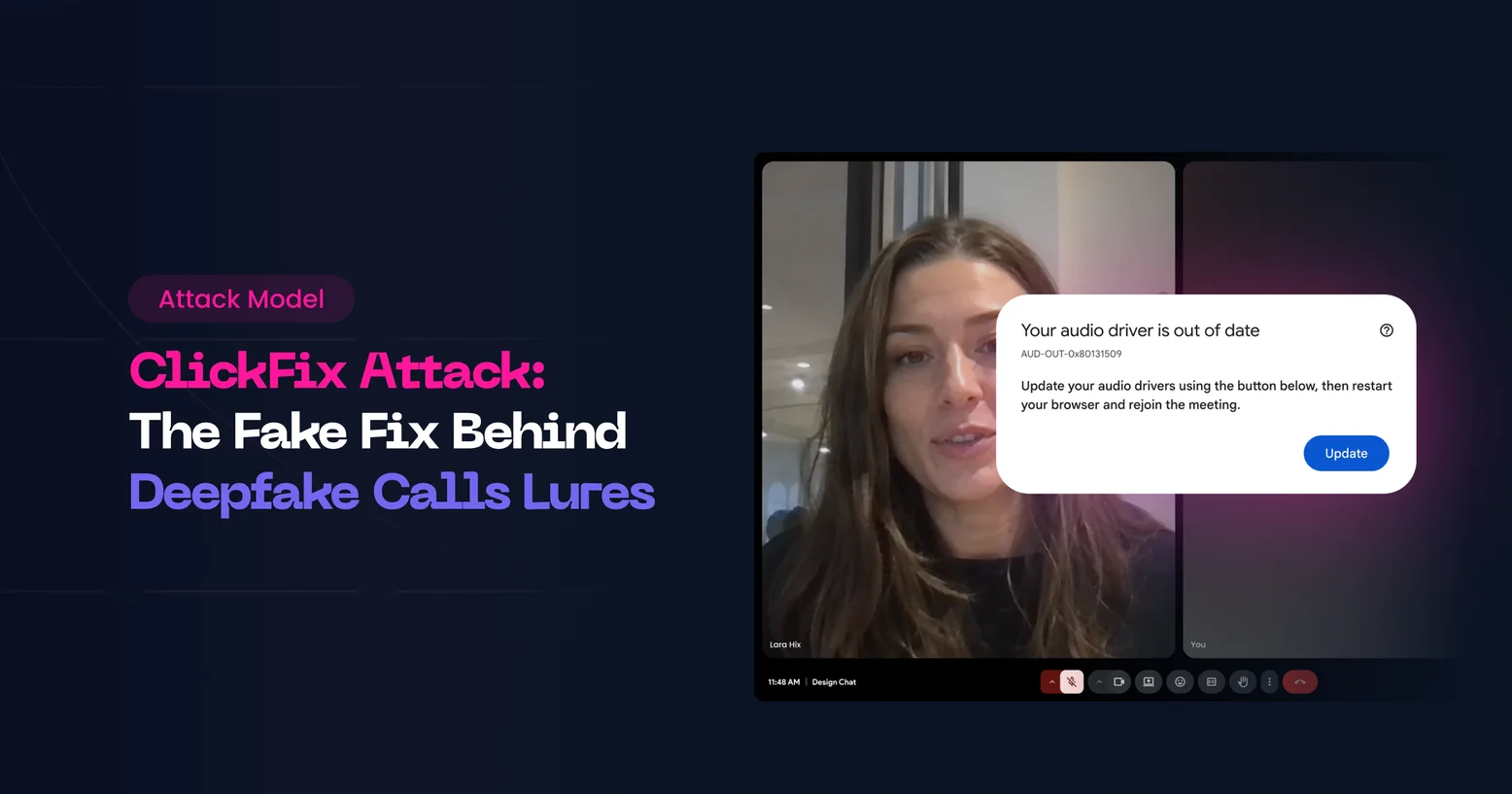
A ClickFix attack tricks a person into running a malicious command themselves, framed as a fix. On a deepfake video call, the fix comes last: the executive's audio fails, a prompt says an audio driver is out of date, and the employee runs the attacker's code.
Key takeaways
- ClickFix needs no exploit. The victim copies and runs the command, which is why Microsoft has seen it reach devices where EDR is deployed.
- In the case Mandiant documented in February 2026, a hijacked Telegram account, a Calendly invite and a spoofed Zoom page led to a fake audio problem and "troubleshooting" commands that installed seven malware families.
- The deepfake supplies authority. The glitch supplies a reason to act. The fix looks like a platform message, not a request from a person.
- Legitimate meeting software never asks you to paste a command into Terminal, PowerShell or the Run dialog to repair audio.
- You can rehearse the whole chain with a simulation that ends on a fake update prompt, then coach employees on the spot.
What is a ClickFix attack?
A ClickFix attack is a social engineering technique that gets a user to run a malicious command on their own device. A fake error, CAPTCHA or update page copies a command to the clipboard and tells the user to paste it into the Windows Run dialog, Windows Terminal, PowerShell or the macOS Terminal. No vulnerability is exploited: the user performs the execution.
In its August 2025 analysis of ClickFix, Microsoft Threat Intelligence describes campaigns that target "thousands of enterprise and end-user devices globally every day", with PowerShell, mshta, rundll32 and curl as common execution paths and infostealers such as Lumma Stealer as frequent payloads. ESET’s H1 2025 Threat Report measured a 517% rise in ClickFix detections between the second half of 2024 and the first half of 2025.
The classic lures are fake CAPTCHAs, browser errors and document-sharing prompts. Our guide to how the ClickFix attack vector works covers the mechanics, and our analysis of ClickFix campaigns impersonating Microsoft, Cloudflare and crypto services shows how attackers vary the pretext.
Run a ClickFix phishing simulation →
Why does a ClickFix prompt land at the end of a deepfake call?
Because by the end of the call the victim has stopped evaluating the request. A deepfake executive establishes authority and urgency, a technical glitch interrupts the conversation, and the "fix" appears to come from the meeting platform rather than from a person. Running it feels like helping the meeting continue, not like obeying a stranger.
Each stage removes a defense that email-based ClickFix still has to beat:
| Stage | What the attacker gains | What it bypasses |
|---|---|---|
| Meeting invite from a known contact | A trusted sender and a scheduled time | Sender reputation and email filtering |
| Video of a familiar executive | Authority and social pressure to fix things fast | The instinct to question an unknown caller |
| Audio failure | A believable reason to "troubleshoot" | Suspicion: everyone has lost audio on a call |
| Update or troubleshooting prompt | Execution by the victim's own hand | Attachment scanning and exploit protection |
In the same Microsoft analysis, Defender Experts report thousands of devices a month affected by ClickFix execution in early 2025, including environments with EDR deployed. The deepfake call adds a human layer of persuasion on top of a technique that already works.
How did the UNC1069 deepfake Zoom attack work, step by step?
In February 2026, Mandiant documented an intrusion at a cryptocurrency company by UNC1069, a financially motivated actor with a suspected North Korea nexus. The chain combined a compromised Telegram account, a fake Zoom meeting, a video that appeared to be a deepfake and a ClickFix payload.
Mandiant states it could not recover forensic evidence confirming that the video was AI-generated. The chain worked either way: the victim believed a senior figure was on the call.
Is UNC1069 an isolated case?
No. In April 2026, Arctic Wolf Labs described a BlueNoroff campaign in which a typo-squatted Zoom link opened a page replicating the Zoom or Teams interface, populated with AI-generated headshots, deepfake composites and footage stolen from earlier victims. When audio failed, an overlay announced that the "SDK is deprecated" and offered an "Update Now" button that placed a malicious PowerShell command on the clipboard.
Arctic Wolf identified at least 100 victims across more than 20 countries, linked over 80 typo-squatted Zoom and Teams domains to the same infrastructure, and found that CEOs and founders made up 45% of targets. Recorded victims became material for the next lures. The pattern is not limited to crypto: at Arup, an employee transferred $25 million after a video call in which the senior colleagues on screen were deepfakes, as the World Economic Forum reported. A callback on a known number before any payment or access change is the control that breaks this chain.
What are the warning signs of a ClickFix prompt during a video call?
The strongest signal is the request itself: Zoom, Microsoft Teams and Google Meet never ask users to paste a command into a terminal to fix audio or update an SDK. Any meeting that ends with "copy this and run it" should be treated as an attack, whoever appeared on screen.
Other signs to train employees on:
- The meeting link points to a domain that is not the platform's own, such as a lookalike with extra letters or an unfamiliar top-level domain.
- The invitation arrived through Telegram, LinkedIn or a scheduling link from a contact you have not met on that channel before.
- The meeting page opens in the browser and asks for your camera and name before anyone speaks.
- Participants' video loops, cycles or never reacts to what you say.
- A button copies text for you, or the page asks you to press Win+R, open Terminal or open PowerShell.
- Pressure to fix the problem quickly so the "executive" is not kept waiting.
The response is simple: leave the call, run nothing, and contact the person through a channel you already know. Report the invite to the security team so other recipients can be warned.
Which technical controls reduce ClickFix exposure?
Microsoft recommends disabling the Run dialog through Group Policy where it is not needed, enabling PowerShell script block logging, configuring Windows Terminal warnings for multi-line pastes, and using enterprise-managed browsers with web protection. These controls narrow the attack on Windows. They do not cover the macOS Terminal used in the UNC1069 intrusion, so the human decision still needs testing.
How can you test a deepfake call ClickFix attack safely?
Run a simulation that reproduces the full chain, from the meeting invite to the fake update prompt, then coach employees who follow it. A classic ClickFix simulation tests the lure in email and on the web. A deepfake call simulation tests the moment when authority, a glitch and a "fix" arrive together.
| Classic ClickFix simulation | Deepfake call ClickFix simulation | |
|---|---|---|
| Lure | Fake CAPTCHA, browser error or document prompt | Meeting invite from a selected executive |
| Pressure | Curiosity or a blocked task | Authority of a familiar face and a live call |
| Trigger | Error message on a web page | Audio glitch, then a fake update prompt |
| What it measures | Who runs a pasted command | Who acts on an executive's call without verifying |
Arsen's deepfake video call simulation can follow that sequence. Employees receive a realistic meeting invitation impersonating one of your executives, join a pixel-accurate replica of the call interface and meet a deepfake likeness of that executive. A glitch interrupts the call, an in-call chat asks "can you hear me?", the call drops and a prompt claiming the audio driver is out of date appears. That prompt is a ClickFix stand-in. Employees who follow it go straight to just-in-time coaching.
The fake update prompt is one scenario among others, featured here because it is one of the most common endings in real attacks. Arsen builds custom scenarios and environments for each company, department or internal profile: precise, workflow-specific scenarios for finance teams who approve payments, or broader scenarios that measure risk at scale across larger teams. Arsen's team builds the persona, the scenario, the assets and the send calendar, and your team approves them.
Each simulation is paired with adaptive, interactive awareness lessons that strengthen how teams respond the next time a call feels wrong. Results sit alongside phishing and vishing campaigns in the same reporting. Deepfake simulation is sold as an add-on to an Arsen contract.
Available platforms for deepfake video call simulations:
 Microsoft Teams
 Google Meet
 Zoom
Learn more about deepfake simulation →
FAQ
-
A ClickFix attack is a social engineering technique that convinces a user to copy and run a malicious command on their own computer, usually presented as a fix for an error, a CAPTCHA or an update. Because the user executes the command, the attack needs no software vulnerability.
-
By the end of the call, the victim trusts the meeting and wants it to work. A staged audio failure gives a natural reason to "troubleshoot", and the prompt appears to come from the platform, so the victim runs the command without treating it as a request from the attacker.
-
Yes. In the UNC1069 intrusion documented by Mandiant, the victim ran macOS Terminal commands presented as audio troubleshooting, and one of them downloaded and executed a remote script. The same fake page also offered Windows commands.
-
Not reliably. Microsoft observed thousands of devices a month affected by ClickFix execution in early 2025, including where EDR was deployed. Disabling the Run dialog, logging PowerShell and warning on multi-line pastes reduce exposure, and employees still need to recognize the request.
-
Check the domain before joining: lookalike domains add letters, regions or unusual extensions to the real name. Treat any meeting page that asks you to run a command, install an "SDK" or update a driver from the browser as malicious, and confirm the meeting with the organizer through a known channel.
-
No. The victim reported a video that appeared to be a deepfake of a cryptocurrency CEO, but Mandiant could not recover forensic evidence to confirm AI generation. Arctic Wolf separately documented fake meeting pages using AI-generated headshots, deepfake composites and stolen footage.